Reading ability, blank slatism, homelessness, and who our society works for
A medley of related thoughts, here

I commented a couple of weeks ago that I had concluded that practical illiteracy is actually much higher in the US population than is officially acknowledged. The comment was immediately prompted by the daughter and I having dinner at Chipotle after school, where I watched a man trying to fill out a job application, and struggling with it because, it seemed to me, he was having difficulty just reading the instructions.
I mentioned this on Twitter and received a couple replies of interest. The first person suggested I was probably seeing a man on some form of welfare that required him to periodically apply for a job. This person actually followed up with a comment that, as the modern world is constituted, some people are just not suitable for employment, yet we try to force them into it anyway. But a second person said… does it really matter if a cook can’t read? For most of human history your cooks couldn’t read and that was fine. But now it’s expected.
A larger comment here would be that, for people who surpass a certain base level of intelligence and self-control, the modern world works pretty well. But for people who fall below that level it doesn’t, and we literally don’t know what to do with those people. The most difficult cases end up receiving infinite amounts of state and private aid which keeps them alive, but basically leaves them in permanent unproductive squalor. (And if you’re the first person who replied to me above, maybe you think this is all we can do, I don’t know.)
I would not claim that all of these folks should be confined to a mental institution, but the following graph, which you’ve probably seen, is one visual example of “we tried, and we don’t know how to make some of these people into productive members of society”.
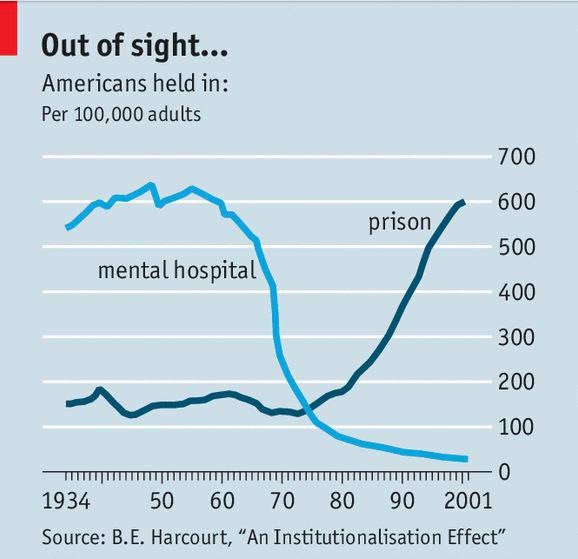
One way to read this graph would be, we used to put about 1 in every 170 American adults into a mental hospital. Then we decided that was mean and turned them loose on the streets where, now, eventually they commit a serious enough crime to be put into prison instead. How noble we were to give them their “freedom”.
Part of the problem is that we can’t acknowledge the problem
As I’ve written before, it is a conceit of modern progressivism that if someone is behaving badly or has a bad life, that is because the world has mistreated THEM, it’s an external forces problem. And if we can just get them into better circumstances or get them a better education, their problems will go away. (This has the particularly perverse effect that basically the more poorly behaved you are, the more stuff the state gives you, which doesn’t really sound like a great way to run a society.) But it seems rather obvious that this often isn’t true. Jeremy Kaufman posted the following today.
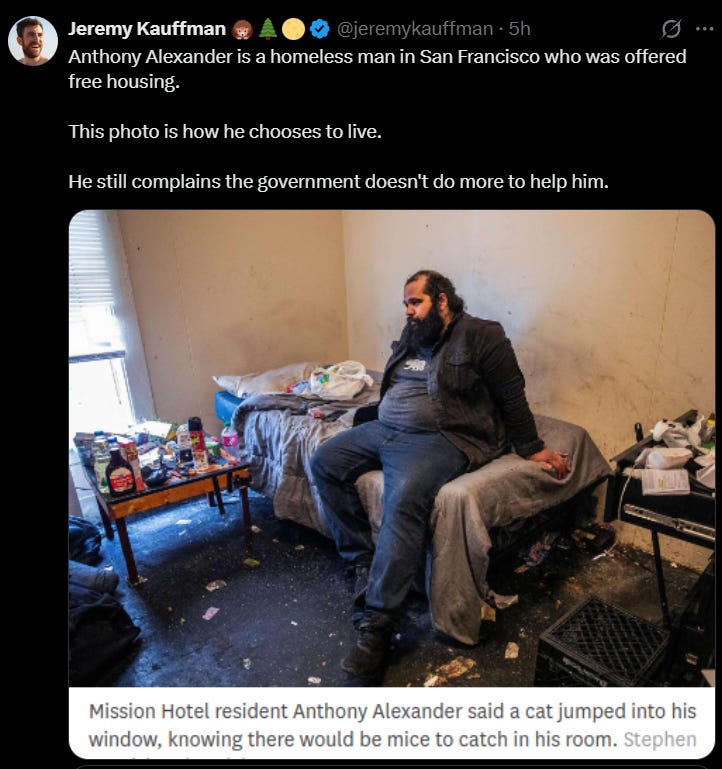
I have to write a few things in this post that will sound not-nice, but basically, here was a guy living a disordered life outside of a home. We paid to put him in a home, and now… he lives a disordered life inside of a home. Changing the circumstances doesn’t change the man. If you care to, you can also go read replies to Jeremy that say things like “I used to work maintenance for Section 8 housing and the apartments were a disaster”.
And the common people of the world know this. The city of Lansing has a new project to put some of the homeless population into a new community of tiny homes. I hope it works well and, actually, if you carefully select exactly whom you let into it, it could work. But several people have said to me something like “the residents will destroy the community within six months”.
Put another way, we want to believe that because someone couldn’t get a job, say, THEN all these other problems (disorder, drug use, homelessness) appeared in their life, and if we can fix the job problem then we’ll fix the other problems too. But it is sometimes (and I suspect “often”) rather the case that their own personal characteristics contributed to all of the above. The same personal flaws that cause them to keep their own living environment as squalor also keep them from finding and holding a job. The one thing didn’t cause the other, it’s rather sort of “all the same big problem”.
It is also worth quoting a post by Hunter Ash today. He was responding to a video about a guy just evicted, for the eighth time, from his subsidized Section 8 housing for trashing the place and throwing drug parties in it.
Homelessness is not a housing problem. When you “just give them houses, bro” this is what happens.
The response is generally “oh yeah, you also need to give them addiction treatment (that you don’t force them to comply with), doctors, therapists, spending money, etc etc”
And the truth is, in many cases, nothing will fix these people. They were born with defects we don’t know how to fix. But even if the progressive plan would work, at some point we have to consider the astronomical cost and whether it’s worth it. You need to be able to answer the question “how much is it worth paying to treat someone whose best-case outcome is being a cashier?” The answer cannot be “whatever it takes.” That’s civilization-destroying lunacy. A bleeding heart is not a substitute for calculation, and usually impedes it.
I hesitated to quote that, because it does sound a bit like “we can’t help any of these people and maybe we should kind of stop trying”, and I don’t think that is true. There is a spectrum here, and some people you can help. But he is right to at least say, some of them we don’t know how to fix. Maybe a magical new medication that rewires the brain gets invented next year, but right now we don’t know how to do it. Their problems, sorry blank slate fans, are not their external circumstances, their problems are something deep and inherent within them.
So what are we supposed to do about it?
It is clear to me that a fair number of the folks you meet on the street do need to be confined to some sort of institution, for a short time or for a long time - drug addicts are the obvious example here. As Hunter says above, for some reason our society is loathe to force them into treatment programs. But if you don’t force them into these programs, then eventually they’ll stab someone and go to jail, or just die of their addiction on the street, degrading the public environment for everyone else in the meanwhile. Probably we shouldn’t wait for that to happen.
I did also want to commend Chris Arnade’s recent excellent piece to you, “America and Public Disorder”. Chris (who has traveled the world) points out in that piece that these problems (think people living on the street) are especially bad in the United States, and he sort of blames our love of freedom for that. If your brain is badly broken in some way, or if you aren’t very intelligent, living in a culture that has extremely strong social norms creates walls that help force you into a reasonable existence. America does not have those walls because we instead say things like “go find yourself, you can be whatever you want to be”, and so for us those people instead end up doing all manner of destructive things to themselves and to the public at large. We sort of “owe them” something like treatment in an institution as payment for being freedom people, Chris says.
For some of the rest… someone mentioned to me recently that one way cities used to handle homelessness was to say here, you can have this room for the night, but you have to sweep the sidewalk first. Maybe we need to get back to something like that. We will provide you with housing, but we aren’t just going to throw money at you, here is some basic task you must do to earn it. The task isn’t really worth the room but that’s OK, it’s something. And there is probably also something psychologically helpful when you know you worked for this space instead of just having it handed to you.
Just yesterday I talked to a man who was setting up a tent during daylight, on a fairly busy street. He said he's 53, a college graduate; he was fairly well-spoken, at the moment at least wasn't drug-addled. When I said, "You're going to die early, living outside all the time. There's shelter space available, and the city gives plenty of services to you for living outdoors [trash pick-up, free food, etc.]," his essential response was that he doesn't like the rules that come with being in a shelter, and he's not really sponging off people.
I think people living outdoors in cities tend to be capable at a certain level ("street smarts"), but they're very set in their ways, and psychologically and physically brittle.